Also in Fights
Oulipo Set Rules in Order to Break Different Ones
The Night Hernani Opened and the Pit Fought Back
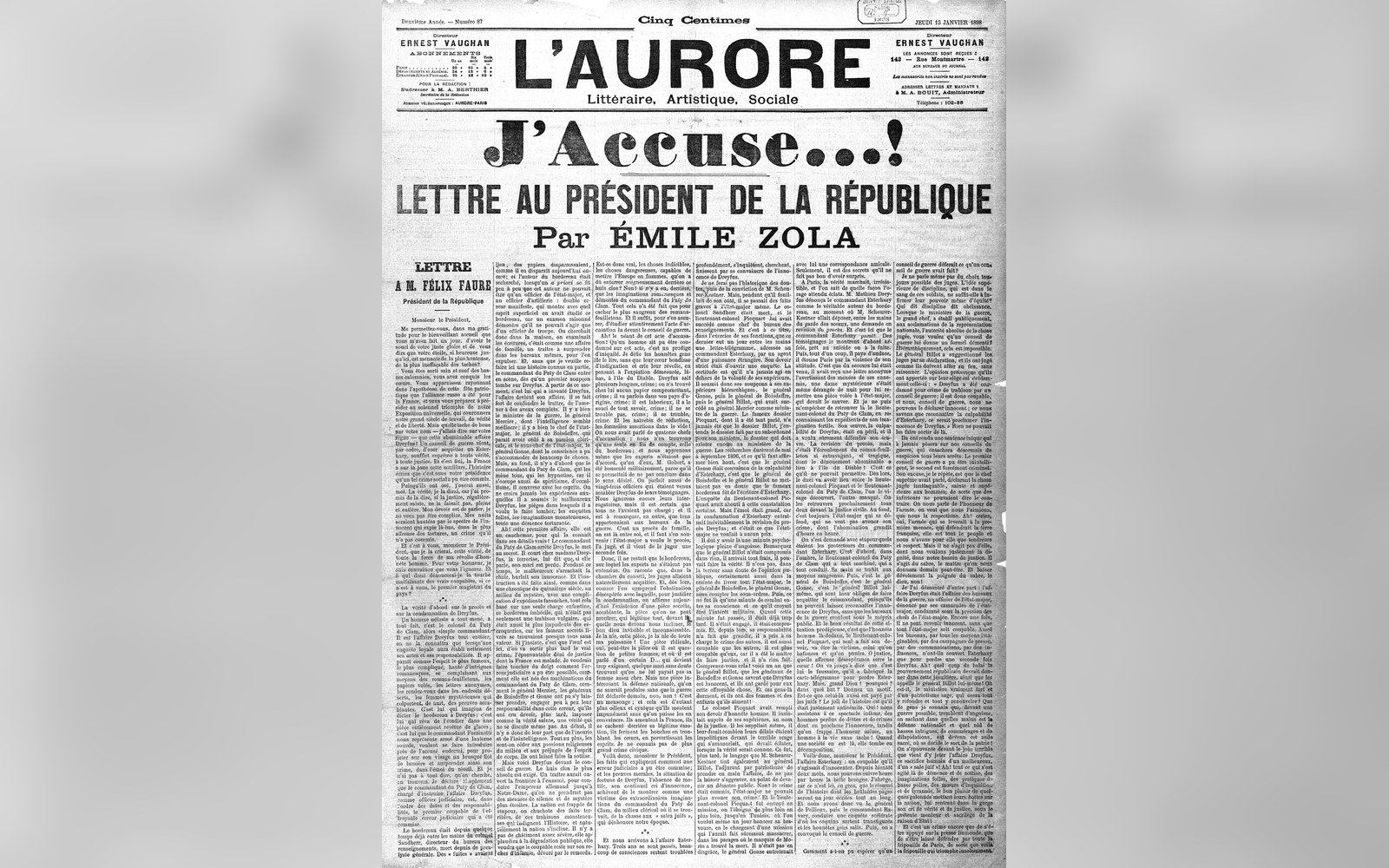
The most consequential piece of writing in French journalism was set in newspaper type, not bound between covers — and its famous title was someone else's idea.
The Letter That Became a Headline
On 13 January 1898, readers in Paris found an open letter from Émile Zola on the front page of L'Aurore, a daily Republican newspaper. The letter was addressed to Félix Faure, President of the Republic, and ran to approximately four thousand words. Zola had written it in a matter of days. The headline — J'Accuse…! — was chosen by the newspaper's editor, Georges Clemenceau ↗, the future Prime Minister of France, who understood immediately that the letter's repeated rhetorical accusation was the thing a newspaper front page could amplify into a slogan. Zola had simply titled his text "Lettre à M. Félix Faure, Président de la République." Clemenceau gave it its life.
The context was the Dreyfus Affair, by 1898 already four years old and increasingly toxic. Alfred Dreyfus, a Jewish officer in the French Army, had been convicted in 1894 of passing military secrets to Germany on the basis of evidence later shown to be forged and suppressed. A second officer, Ferdinand Walsin Esterhazy, had been court-martialled in January 1898 and acquitted despite substantial evidence against him. It was this acquittal that prompted Zola's letter. Working through the affair's documentary record, he accused named military officers and officials of having fabricated evidence, covered their tracks, and allowed an innocent man to remain on Devil's Island. The accusations were specific, structured, and signed.

Print Run, Prosecution, Exile
L'Aurore sold approximately 300,000 copies ↗ that day — a figure cited consistently by historians of the Third Republic and several times the paper's usual circulation. Copies were passed hand to hand in cafés and read aloud in streets. The letter polarised opinion in ways that remapped French intellectual and political life: the term intellectuel as a collective noun, applied to those who signed petitions in Dreyfus's support, gained its modern sense in the weeks that followed.
Key facts and figures
Zola's decision to publish was also a legal calculation. French defamation law required that a prosecution be brought, which would force a public hearing at which the Dreyfus evidence could be examined in open court — something the Army had so far prevented. The strategy worked in one sense: a trial followed in February 1898. But the result was a conviction. Zola was found guilty of libel against the military authorities, sentenced to a year's imprisonment, and ordered to pay a fine. His appeal produced a retrial, and before it concluded he fled to England in July 1898, living in rooms in Norwood, south London, and later in Weybridge.
He remained in England for nearly a year, unable to return without risking immediate imprisonment. He came back to France in June 1899 after the political climate had shifted sufficiently to make his return viable. Dreyfus himself was brought back from French Guiana for a second court martial at Rennes in August 1899, convicted again — though with extenuating circumstances added to the verdict — and then pardoned by presidential decree. His full legal rehabilitation, through the Court of Cassation, came only in 1906 ↗.
Zola did not live to see it. He died in September 1902 from carbon monoxide poisoning caused by a blocked chimney flue at his Paris home. An inquiry returned an accidental verdict, though suspicions of foul play were raised at the time and have never been definitively dismissed.
Chronology
- 1894Alfred Dreyfus convicted, sentenced to deportation to Devil's Island
- January 1898Esterhazy acquitted by court martial
- 13 January 1898J'Accuse…! published in L'Aurore
- February 1898Zola convicted of libel
- July 1898Zola flees to England
- June 1899Zola returns to France
- August 1899Dreyfus's second court martial, Rennes; convicted, then pardoned
- September 1902Zola dies in Paris
- 1906Dreyfus fully rehabilitated by the Court of Cassation
The letter itself belongs to the history of the French press as much as to French literature. It demonstrated that a newspaper front page could function as an instrument of legal and political intervention — that journalism, set in type and sold on a street corner, could put the machinery of justice under pressure in ways a pamphlet or a novel could not. The headline was Clemenceau's. The consequences were everyone's.