Also in Writers
Ernaux and the Word She Won't Use
The Cork-Lined Room at 102 Boulevard Haussmann
The woman who wrote the Claudine novels spent years watching a man sign them.
The Locked Desk
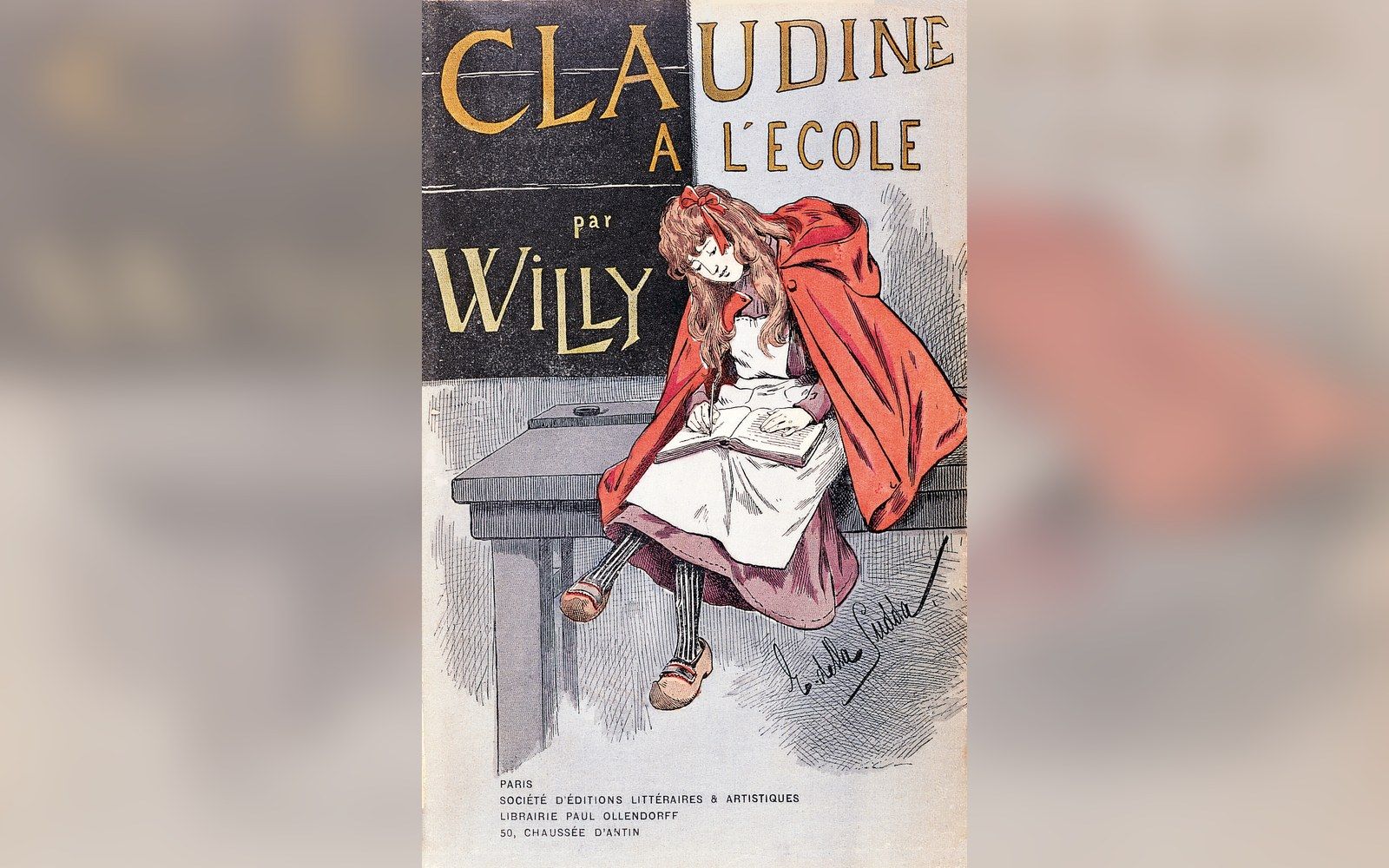
Sidonie-Gabrielle Colette was in her mid-twenties when her first husband, Henry Gauthier-Villars — known everywhere in Parisian literary and music-criticism circles as Willy — recognized that the school-days notebooks she had filled with memories of provincial girlhood were commercially usable. He edited them, added racy passages to sharpen their appeal, and published Claudine à l'école in 1900 under his own name alone. The book was an immediate success, and three sequels followed through 1903: Claudine à Paris, Claudine en ménage, and Claudine s'en va. All appeared as Willy. Colette's name appeared on none of them.
The arrangement was not merely a matter of convention. Willy ran what amounted to a literary workshop, employing ghostwriters and collaborators to sustain his prolific output as a critic and popular novelist. Colette was, at the outset, one contributor among others in that economy — except that the Claudine books were substantially hers. The situation was compounded by the contracts: Willy sold the rights to the Claudine series outright to the publisher Ollendorff, which meant that when Colette and Willy separated in 1906 and formally divorced in 1910, she had no legal claim on the novels she had written. The rights, and the royalties, remained his.
Key dates
- 1900Claudine à l'école published under Willy's name alone
- 1904Dialogues de bêtes appears under "Colette Willy," her first published use of her own name
- 1906Separation from Willy; divorce finalised 1910
- 1910La Vagabonde published; joins Le Matin
- 1920Chéri published
- 1936Mes apprentissages published, her account of the Willy years
- 1945Elected to the Académie Goncourt
- 1949Becomes president of the Académie Goncourt
- 1954Death; state funeral
The recovery of her name was slow and undramatic by the standards of literary scandal. From around 1904 onward, she began publishing under the signature "Colette Willy," a two-name form marking a first, incomplete assertion of selfhood. It appears on Dialogues de bêtes (1904), the animal sketches that signaled a different register from Claudine — quieter, more observational, already identifiable as the prose style that would characterize her mature work. Later editions of some Claudine titles were eventually reattributed to carry both names, and still later to Colette alone, though this process unfolded across decades and the original Willy-only editions remained in circulation.
After Willy: The Journalist and the Academician
Once free of the Willy arrangement, Colette turned to journalism and the music hall, performing as a mime and dancer in productions that scandalized bourgeois opinion without much troubling her. Her literary career, now prosecuted entirely under her own control, produced the work that established her permanent standing: La Vagabonde (1910), Chéri (1920), Le Blé en herbe (1923), and La Naissance du jour (1928), among many others.

Her connection to Le Matin ↗, the Parisian daily, was substantial and professionally defining. She joined the paper around 1910 and eventually became its literary editor — one of the very few women to hold such a position at a major French newspaper of that era. The relationship with Le Matin also brought her into contact with Henri de Jouvenel, the paper's co-director, whom she married in 1912. It was a position she occupied with full editorial authority, commissioning and publishing fiction and criticism.
The institutional capstone came in 1945, when Colette was elected to the Académie Goncourt, the body that awards the Prix Goncourt annually at the Drouant restaurant. She served as its president from 1949 until her death in 1954 — the first woman to lead the academy. The position represented a formal recognition by the French literary establishment of an authority she had, in practice, exercised on the page for fifty years.
The Claudine contracts were never undone in any complete legal sense. What changed was public understanding, driven partly by Colette's own memoir writing — including Mes apprentissages (1936), her unsparing account of the Willy years — and partly by the accumulating weight of her subsequent reputation. By the time she died and was given a state funeral, the books signed Willy were universally understood to be hers. The credit followed the fame, even if the contracts never caught up.