Also in Rooms
The Reading Room on the Place du Panthéon
Two Shops, One Name, Two Streets
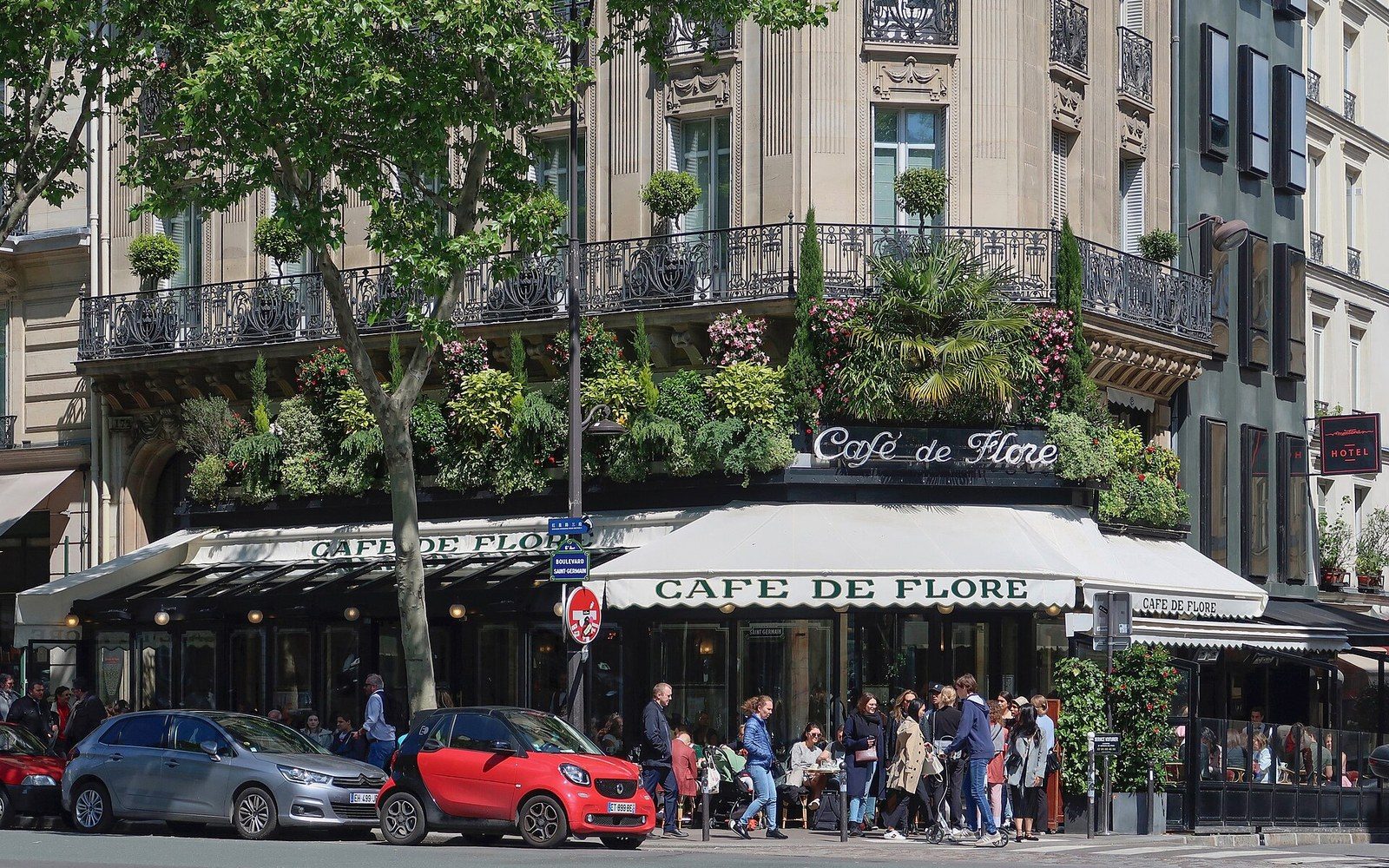
The Café de Flore's association with existentialism is real — but the dates are wrong by about two years.
What the Diaries Say
The received image is seductive: Sartre and Beauvoir at their corner table in the Café de Flore, Boulevard Saint-Germain, arguing philosophy into the months after the Liberation. Journalists fixed that picture early, and it has never quite shifted. The problem is that Beauvoir's wartime journals and Sartre's letters document their heaviest use of the Flore in a different period entirely — the Occupation winters of 1940 to 1943.
The logic was practical before it was intellectual. The couple's separate hotel rooms on the Left Bank were unheatable; the Flore kept its coal fire burning into the early afternoons, and the management tolerated long, uninterrupted working sessions. Sartre is documented writing substantial portions of L'Être et le Néant (1943) at the café, and Beauvoir worked through drafts of L'Invitée (published the same year) at what became a near-daily routine. The table was a heated office, not a salon.
By the Liberation in August 1944, the dynamic had already changed. Sartre in particular was increasingly drawn into public and journalistic life — he was preparing to found Les Temps Modernes with Beauvoir and Merleau-Ponty, and the editorial demands of that journal ↗ moved the centre of gravity away from a café table. The couple's correspondence from 1945 onward describes a social life far more dispersed than the Flore mythology implies: dinner parties, lecture circuits, transatlantic travel, the pressures of an unexpected celebrity that the postwar press had generated largely by projecting the Occupation-era café image forward in time.
What 1945 actually produced at the Flore was a different clientele performing a version of a scene they had read about. Boris Vian, the novelist and jazz trumpeter, recorded in his journals that the café by late 1944 had become something closer to a literary tourist destination — the tables occupied by writers who had come to be seen in the place where Sartre had worked, while Sartre himself was often elsewhere. The Occupation had created the mythology; the Liberation created the audience for it.
Chronology
- 1940–1943documented period of Sartre and Beauvoir's intensive daily use of the Flore
- 1943publication of Sartre's L'Être et le Néant and Beauvoir's L'Invitée
- August 1944Liberation of Paris
- 1945founding of Les Temps Modernes; the Flore's mythology solidifies in the press
None of this diminishes the Flore's genuine importance. The heating was real, the working hours were real, and L'Être et le Néant was a genuine café production. The correction is only one of timing: the philosophically productive Flore belonged to the worst years of the war, not the famous ones immediately after.