Also in Rooms
The Flore in 1945 Was Not What People Think It Was
What the BnF Keeps Under Glass
A cast-iron vault above the Seine's Left Bank has held readers in place since 1851.
Henri Labrouste's Iron Argument
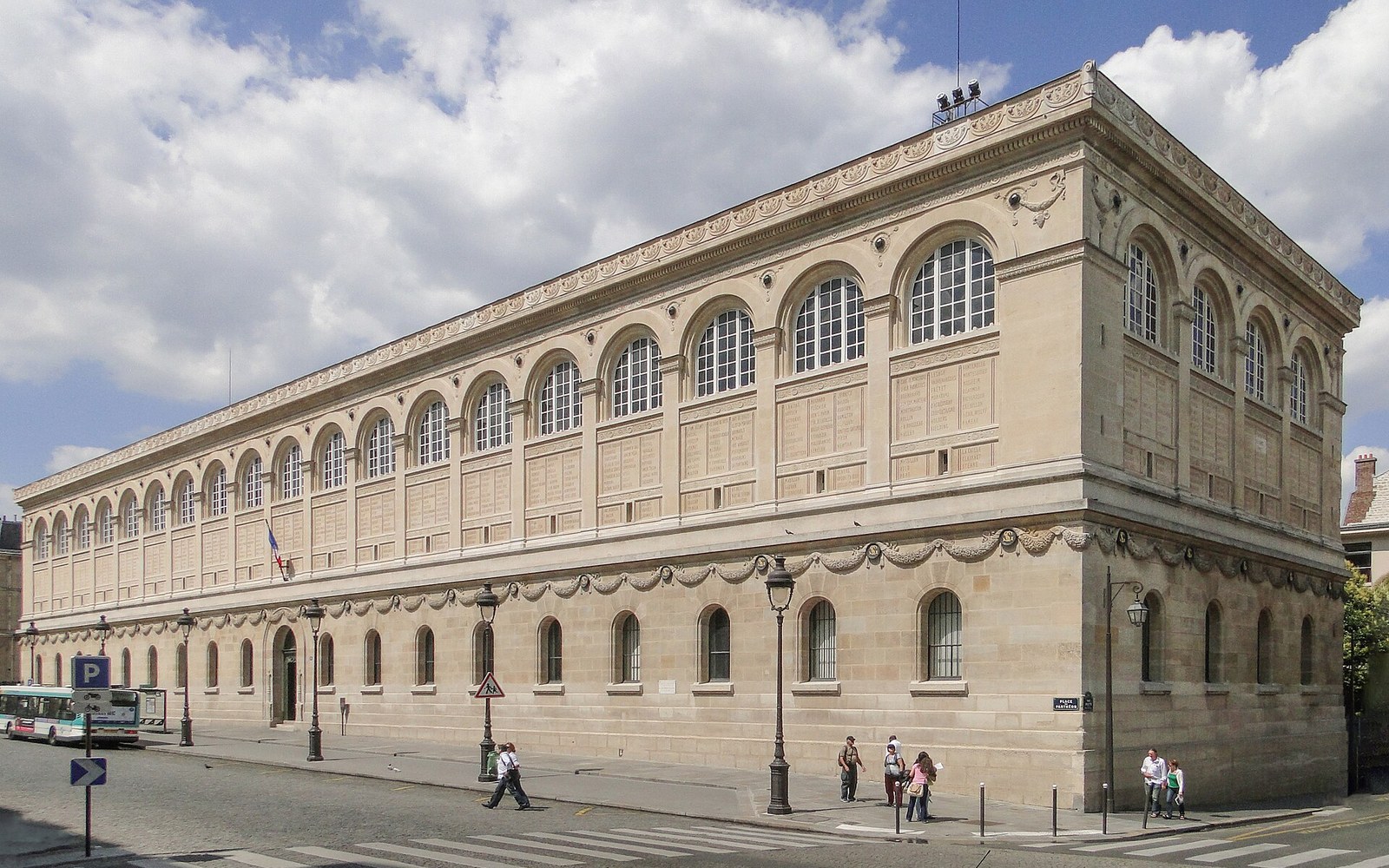
The Bibliothèque Sainte-Geneviève occupies the north flank of the Place du Panthéon in the fifth arrondissement, directly opposite the monument that contains the remains of Voltaire, Rousseau, and Victor Hugo. The building itself makes a quiet counter-argument: the Panthéon freezes its inhabitants in stone; the library across the square puts their books to daily use.
The structure was designed by Henri Labrouste, who won the commission in 1838 and spent thirteen years on it before the doors opened in 1851. Labrouste was a product of the French Académie des Beaux-Arts tradition who had become, during his years in Rome, something close to a heretic — convinced that structural material should be honestly expressed rather than hidden inside classical cladding. The Bibliothèque Sainte-Geneviève gave him room to say so. The exterior is restrained, a long Renaissance-inflected rectangle in cut stone, its façade inscribed with the names of nearly nine hundred authors whose works the library holds. But the interior is the point.
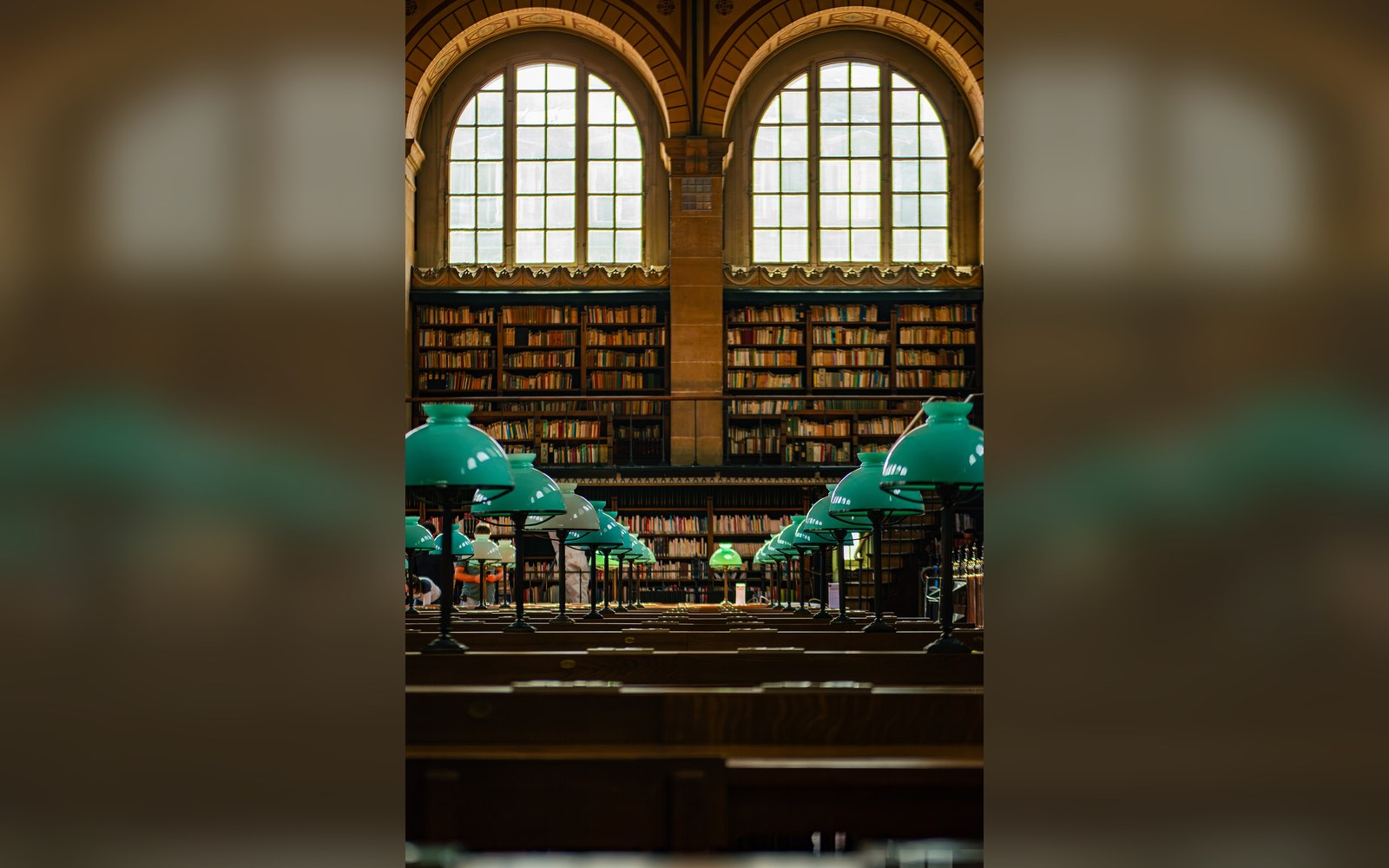
The main reading room on the upper floor is a single vast space divided down its length by a row of slender cast-iron columns supporting two parallel barrel vaults ↗. The vaults are themselves iron, their framework visible, the spandrels filled with ornamental iron tracery that Labrouste designed with a lightness that masonry cannot achieve. Light enters from high windows along both sides. The effect — described by architectural historians as a pivotal moment in the emergence of structural iron as a building language rather than an engineering expedient — is one of airy containment: a room large enough to hold several hundred readers and quiet enough that the turning of a page carries.
The room has been in continuous use since its opening. It did not close for the Commune, was not shuttered in either world war, and has absorbed the successive furniture changes and electric-light installations that any working institution accumulates, without losing the quality Labrouste gave it. The reading room remains open to all adults ↗ presenting valid identification — no affiliation to a university or research institution is required — which distinguishes it from many French research libraries and has made it, for generations, a genuinely democratic working space.
Key dates
- 1838Labrouste wins the commission
- 1851Library opens to the public
- Collection origins trace to the collegiate church of Sainte-Geneviève, secularized during the Revolution
A Library of Record, Not of Fiction
The Bibliothèque Sainte-Geneviève traces its institutional origins to the collegiate church of the same name, whose library was secularized during the Revolution and subsequently enlarged. Its collection emphasis is humanist: theology, philosophy, classical literature, history, and the sciences of the early modern period. It is an associated library of the Université Paris 1 Panthéon-Sorbonne, which reinforces its orientation toward the scholarly rather than the recreational. Alongside its printed holdings, the library holds manuscript collections and significant runs of early printed books.
The reading room consequently draws a specific kind of visitor. Students from the adjacent Sorbonne have filled the long tables since the nineteenth century, and the room functions today primarily as a working library for humanities research. The Bibliothèque nationale de France's great manuscript treasures may reside across the river, but for a doctoral student working on seventeenth-century theology or a translator tracing a source text through early editions, the Sainte-Geneviève is often the more practical address.
Among writers, the room's most celebrated regular was the young André Gide, who worked there in the 1890s. The poet Paul Verlaine is also recorded as having used its collections. More recently, the room appears in the notebooks and correspondence of numerous twentieth-century writers and scholars — less as a celebrated haunt in the manner of the Café de Flore and more as a place of serious, uninterrupted work, which is precisely what Labrouste designed it to be.
The building in numbers
That continuity is the room's real distinction. A building from 1851 that still functions for the purpose it was built for, without heritage cordons or restricted hours that make attendance a pilgrimage rather than a habit, is not common. The Bibliothèque Sainte-Geneviève wears its age the way a well-made book does: the structure holds, the light is good, and the work gets done.