Also in Houses
Le Livre de Poche Changed the Price of Reading in 1953
What the Pléiade Promises the Reader
The nouveau roman — a loose grouping rather than a school with a manifesto — crystallised around Minuit through the 1950s and early 1960s. Alain Robbe-Grillet's Les Gommes appeared on the list in 1953; his polemical essays, collected as Pour un nouveau roman in 1963, gave the tendency its name and its theoretical frame. Marguerite Duras published with Minuit from Moderato cantabile (1958) onward, though her relationship to the nouveau roman label was always ambiguous — her prose was too lyrical, too emotionally direct, to fit comfortably inside Robbe-Grillet's program of objective surface description. Michel Butor, Claude Simon, Robert Pinget, and Nathalie Sarraute also appeared on the list, and the critic Roland Barthes wrote the intellectual scaffolding that allowed the movement to be taken seriously internationally.
Key figures
What united these books was not a shared technique but a shared refusal: of the well-made plot, the rounded character, the narrator who knows things with confidence. Minuit's back catalogue from the Occupation years gave that refusal a moral weight it might not otherwise have claimed — as if the house that had survived by operating in silence had earned the right to question the conventions of narrative voice.
The physical object the house produced was notably austere: plain white covers, minimal typography, nothing decorative. That austerity was partly economical and partly principled, and it became a recognisable identity, as legible in a French bookshop as Gallimard's NRF cover was in its own register. The Minuit cover said: no ornament, no sales pitch, look at the text. It was, in a sense, a continuation of the original act — a press that started with no cover at all, just stapled pages moving quietly through occupied Paris.

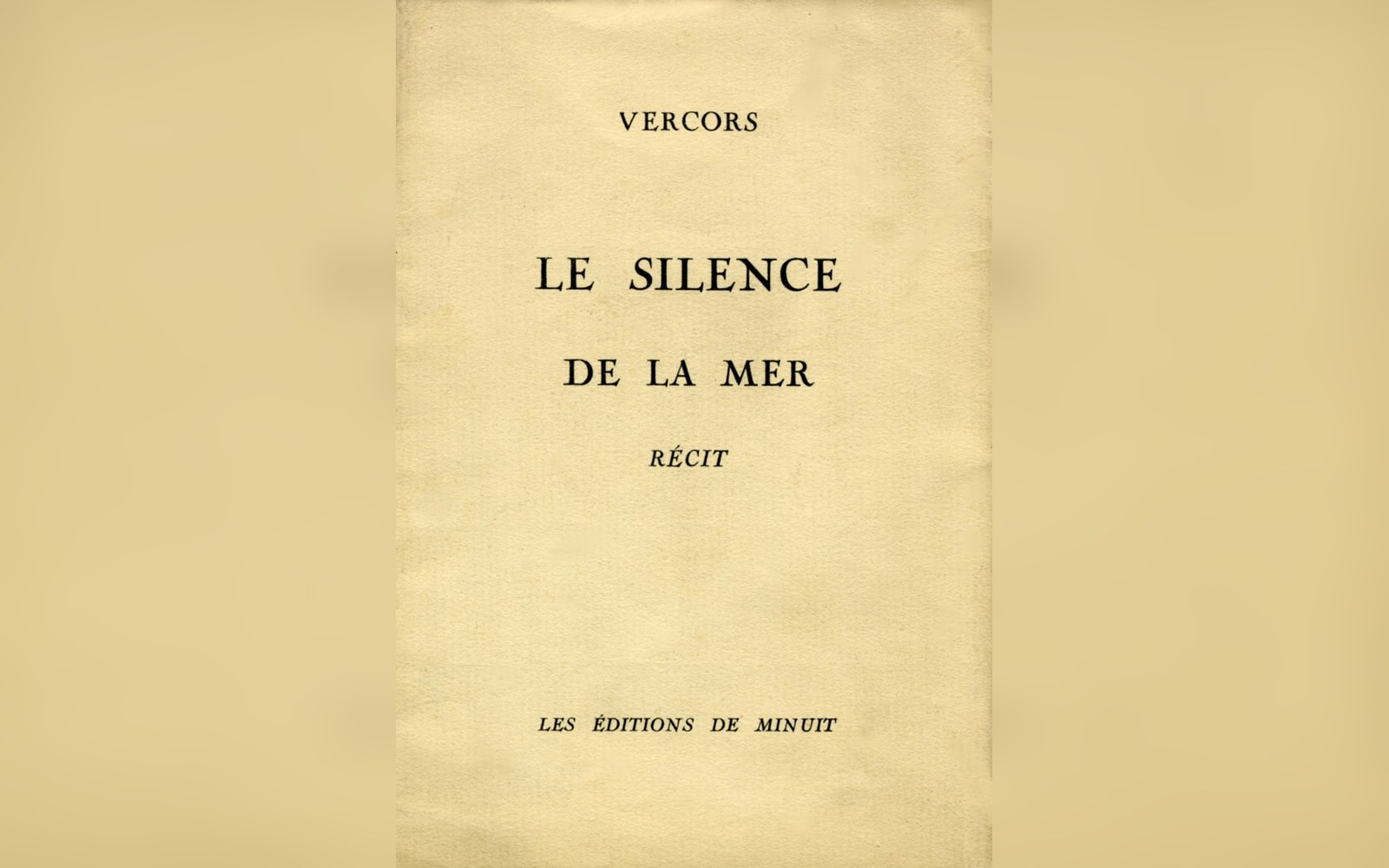
In February 1942, a short novel about silence — about a French uncle and his niece who refuse to speak to the German officer billeted in their home — began to circulate in Paris in stapled paper copies passed from hand to hand. Le Silence de la mer, written under the pseudonym Vercors by the illustrator Jean Bruller, bore a colophon no Paris printer would have dared set in type openly: Les Éditions de Minuit. The press had no office, no catalogue number, no legal existence. It had a name chosen to signal exactly what it was — a midnight operation, working in the dark.
Bruller and the writer Pierre de Lescure co-founded Minuit as a vehicle for literature that the Occupation's censorship apparatus could not reach. The German authorities and the Vichy regime operated an extensive system of literary control, requiring publishers to submit manuscripts and maintain approved lists. Minuit answered by going underground: manuscripts were set and printed in secret, often in private apartments, and distributed through networks of resisters. Between 1942 and the Liberation in 1944, the house published around twenty-five clandestine texts, including work by Louis Aragon, Paul Éluard, and François Mauriac, each appearing under a pseudonym. The print runs were tiny, the physical risk to everyone involved was real, and at least one person connected to the operation was arrested by the Gestapo.
Chronology
- 1942Le Silence de la mer circulated clandestinely; Minuit founded by Jean Bruller (Vercors) and Pierre de Lescure
- 1942–1944approximately thirty-five texts published underground under pseudonyms
- 1944Liberation of Paris; Minuit surfaces as a legal press
- 1948Jérôme Lindon joins as a reader
- 1949Lindon becomes director
- 1951–1953Beckett's French trilogy published (Molloy, Malone meurt, L'Innommable)
- 1953Robbe-Grillet's Les Gommes published
- 1958Duras's Moderato cantabile published
- 1963Robbe-Grillet's Pour un nouveau roman gives the movement its name
- 2001Jérôme Lindon dies after more than fifty years as director
After August 1944, Minuit surfaced legally and faced the problem every clandestine institution faces when it emerges into daylight: what does it become? The prestige of the Resistance years was enormous, but prestige is not a publishing programme. The house changed hands, and in 1948 Jérôme Lindon, then twenty-two years old, joined as a reader. He would become its director in 1949 and run it for more than fifty years, until his death in 2001 — one of the longest and most consequential editorial tenures in modern French publishing.
The house of the nouveau roman
Lindon's Minuit became, above all, the house of formal rupture. It published Samuel Beckett's ↗ Molloy, Malone meurt, and L'Innommable in 1951 and 1953, three novels in French by an Irish writer already living in Paris who had been rejected elsewhere — books without conventional plot, psychology, or resolution, narrated by voices that could not quite stop speaking. Beckett translated most of his own prose into English, and Minuit published both versions, giving the house an unusual bilingual identity at the edge of French literary life.